EU market entry barriers for non-EU fashion brands; A practical guide to organising your data and EU partners
Operating in the EU means deciding how your products reach customers and who takes responsibility along the way. Who imports the goods? Who stores them? Who handles customs? And who is responsible for product safety, VAT and EPR? Whether you are entering Europe or already selling across several markets, those arrangements need to work together.
You may ship orders directly from outside the EU, hold stock in Europe with specialist partners, or establish your own EU business. Each approach changes the practical arrangements for customs, fulfilment, returns and regulatory support.
For each model, establish which responsibilities stay with your brand, which roles an EU partner explicitly accepts, and how information will move between them. A partner that stores your goods or submits declarations does not automatically take on every product-compliance or fiscal obligation.
Reliable data makes that setup workable. Customs representatives, fulfilment teams and compliance specialists need different information from the same product, supplier and transaction records. Gaps or inconsistencies can delay a shipment or make a partner unwilling to accept the risk.
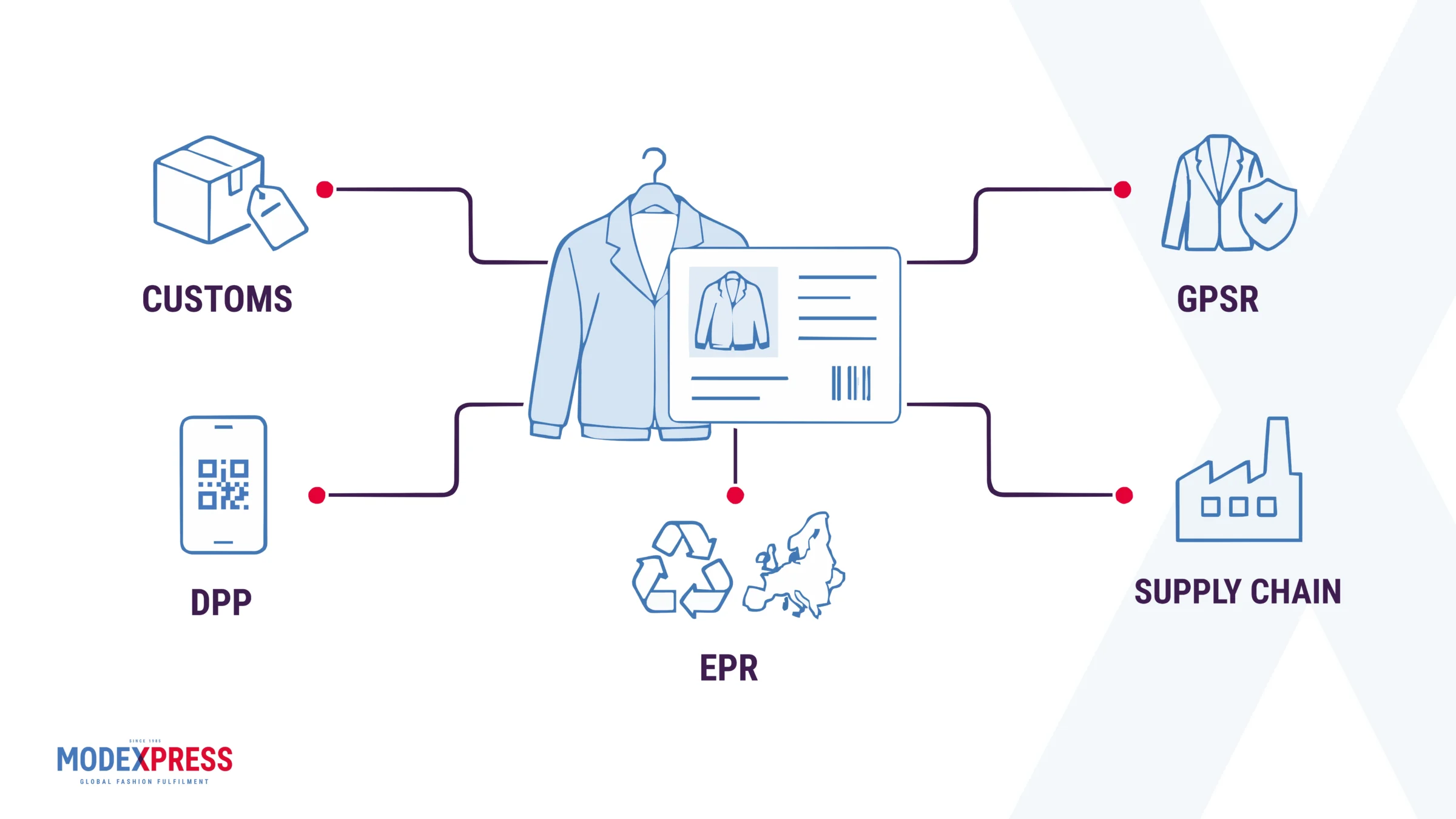
In this guide, we’ll explain how product and supplier records support GPSR, ESPR/DPP, textile EPR, and the Forced Labour Regulation, alongside customs requirements. We’ll also show you how to choose an EU operating model that keeps responsibilities clear without creating unnecessary hand-offs.
Why a customs partner might refuse
If your supplier and transaction records are inconsistent or incomplete, a customs provider may decide the risk is too high. An indirect customs representative acts on your behalf in its own name, so it needs confidence in the information behind each declaration.
Under the Union Customs Code, both the representative and your business can owe the customs debt. Incorrect information can increase the provider’s exposure. If poor data repeatedly passes through its customs administration, it may put its own authorisations and relationship with customs authorities at risk.
Therefore, process quality is an important part of the assessment. You need to decide how the process will work in practice.
- Who approves a tariff code?
- Where is the origin evidence?
- Who checks whether a supplier’s revised specification changes the declaration?
For example, a supplier’s invoice may show where a garment was dispatched from, but that alone doesn’t establish its customs origin.
“When incorrect data enters our customs administration, the risk affects us too. We need to understand how a brand manages its information and resolves errors before we can take on that responsibility.”

What the €3 customs duty changes
Since July 2026, the EU has removed low-value customs-duty relief and introduced a temporary €3 duty for qualifying distance-sale consignments worth up to €150. The charge is applied based on tariff categories within the parcel.
In the Council’s example, one silk blouse and two wool blouses attract €6 because they fall under two different tariff subheadings. The real issue is product data reliability: a wrong tariff classification affects both the declaration and the landed cost across hundreds or thousands of orders. Plan your VAT and customs arrangements together, so they reflect how you sell and ship goods into the EU.
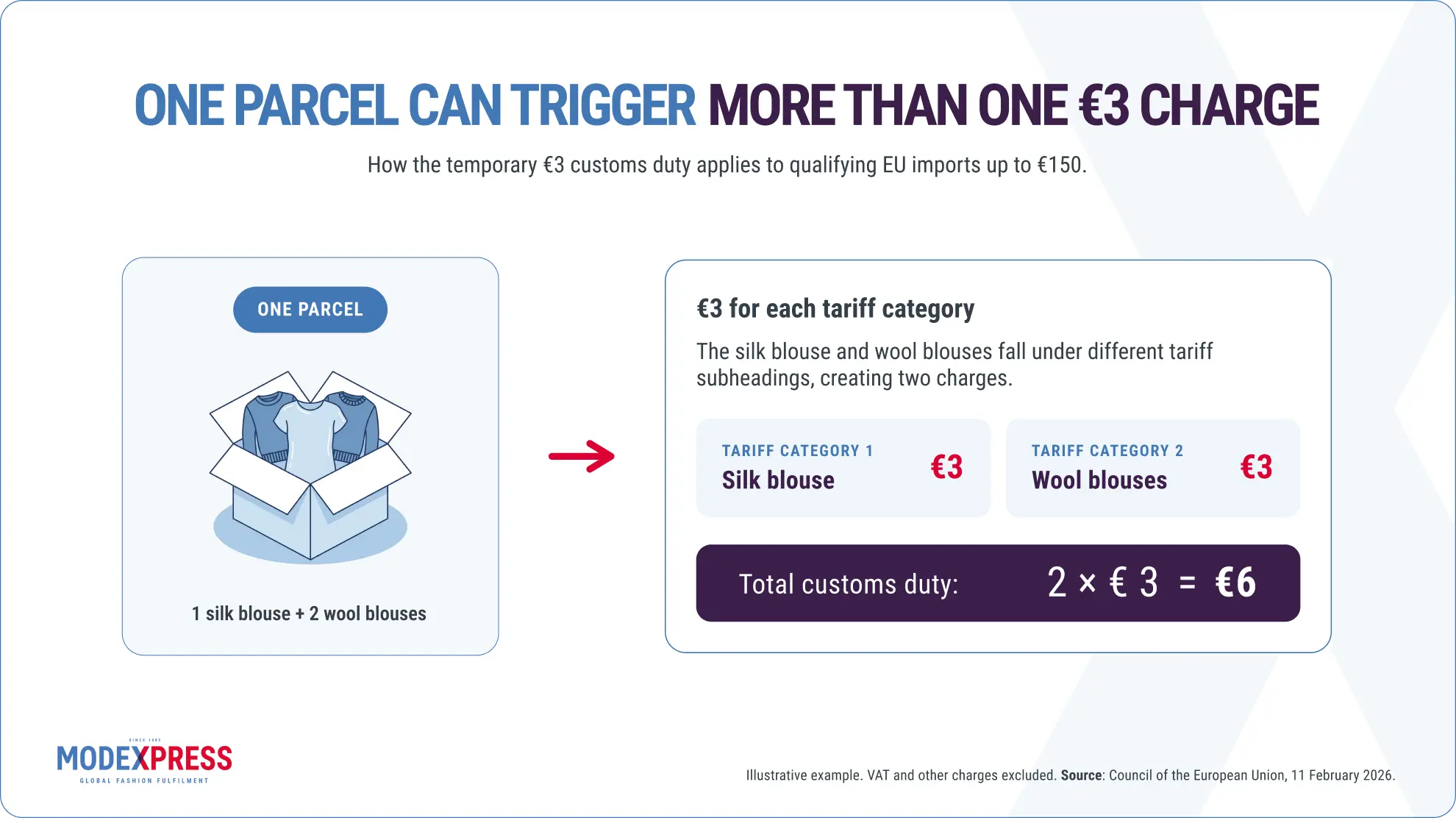
One parcel can trigger more than one €3 charge. VAT and other charges excluded. Source: Council of the European Union.
How GPSR, ESPR/DPP, textile EPR and FLR use your data
When it comes to fashion items, customs need to know the classification, value, and origin. Other regulatory obligations rely on related records, but ask different questions about the garment, as we explain below.
GPSR: who is responsible for product safety?
The General Product Safety Regulation has applied since 13 December 2024. Products covered by the regulation cannot be placed on the EU market unless there is a responsible economic operator established in the EU.
You must also pass this information on to the customer. For non-EU manufacturers, GPSR Article 19 requires online offers to display the EU responsible person’s name and postal and electronic addresses. You must also include manufacturer details, product identification and applicable warnings.
In practice, appoint an internal owner to keep the approved product and safety information current and share it with your EU responsible economic operator and sales teams. Check that labels and online listings use the same approved details, and keep the supporting documentation retrievable when questions arise.
ESPR and DPP: can you maintain reliable product information?
ESPR establishes the framework for Digital Product Passports, but the final textile requirements are still being developed. Start by assigning ownership of your product records and collecting supporting evidence from suppliers. Keep your systems adaptable as the textile-specific requirements are finalised.
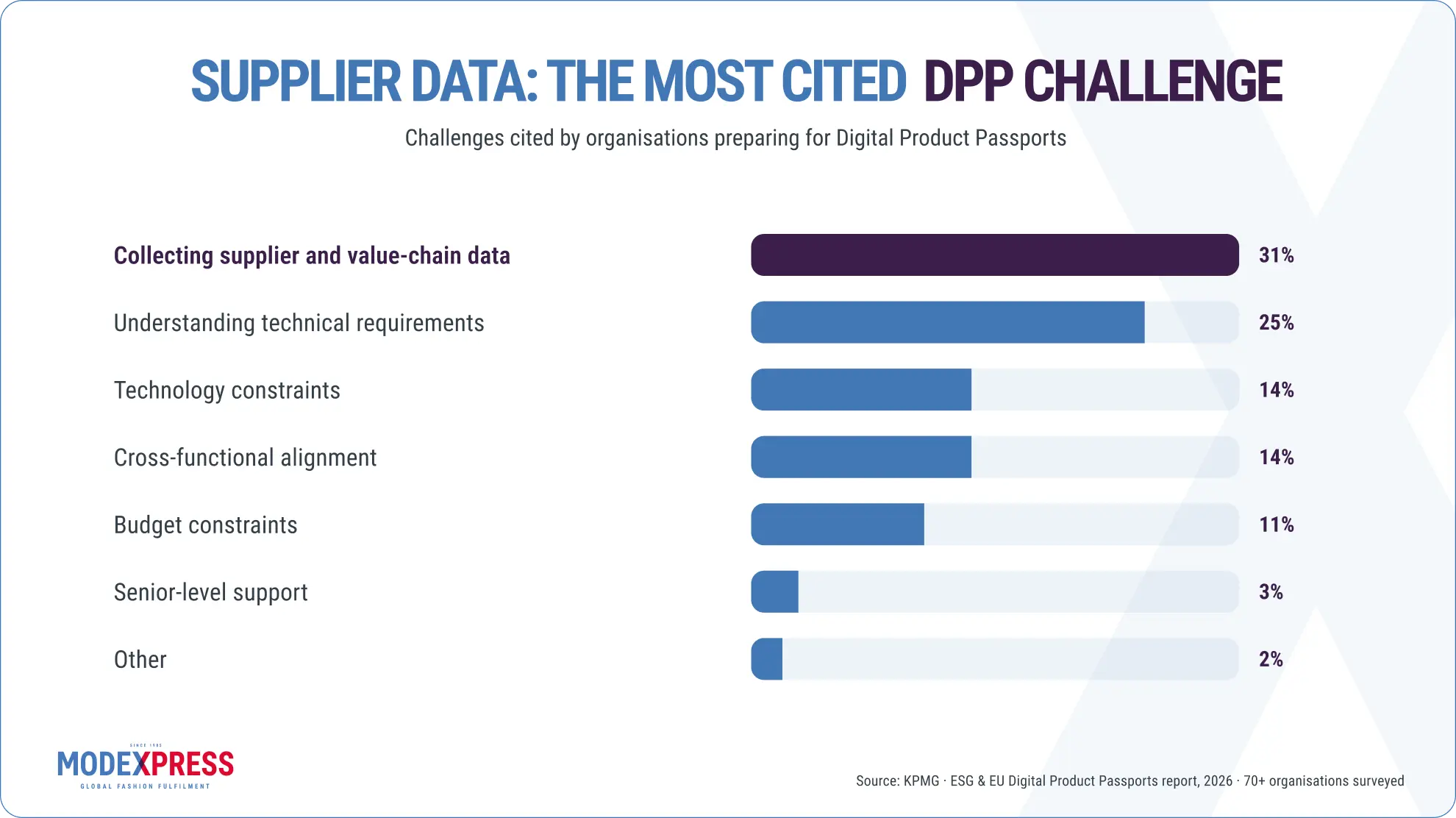
Supplier and value-chain data is the most cited DPP challenge. Source: KPMG, 2026.
In a 2026 KPMG survey, 31% of organisations cited supplier or value-chain data as their biggest Digital Product Passport challenge. The survey covered more than 70 organisations, including fashion businesses, so it gives a useful indication of the difficulties brands face.
The JRC’s textile DPP preparatory study explores how passport information can support other requirements. For instance, if an item’s composition changes, the approved record and supporting evidence must change together. A QR code linked to old information only serves to make the wrong information easier to find. You should be able to trace the information shown for a product back to the evidence supporting it.
Textile EPR: where are your products placed on the market?
Extended producer responsibility (EPR) makes producers responsible for specified aspects of products’ waste management. In the Netherlands, foreign producers supplying covered textiles directly to consumers must appoint a Dutch authorised representative under UPV textiel.
The wider EU framework calls for national textile and footwear EPR schemes. It does not make registration a single EU-wide task.
For each destination market, establish who counts as the producer, including where you sell through a distributor. Assign an owner to maintain product-category and market-level sales or weight records, as required locally, and reconcile them with the registrations and reports handled by your EPR partner.
Forced Labour Regulation: can you retrieve supply-chain evidence?
The EU Forced Labour Regulation applies from 14 December 2027 and prohibits products made with forced labour from being placed or made available on the EU market, or exported.
Under Article 17, operators have 30 working days to respond to a preliminary information request. Formal investigations have a separate response period, normally 30 to 60 working days.
Ask your sourcing team to maintain supplier and production-site information, relevant subcontractor details, and supporting purchasing and due-diligence records. Name a person to coordinate enquiries and test whether the evidence can be retrieved for a specific product or supplier within the applicable response period. Keep a record of how risks were assessed and what action was taken.
Which EU representatives do you need?
“EU representative” can describe several different roles. Before appointing anyone, you should define their legal responsibilities and the services they provide. One company may cover several positions where it is eligible and explicitly agrees, and the overlap must be documented.
For each obligation, ask:
- Who is legally accountable?
- Which risks and tasks have they accepted?
- What records do they require from us?
- Who approves changes to those records?
- Who responds if an authority challenges them?
These questions help prevent a common assumption: that because one partner holds the stock or files a declaration, it also handles every other obligation.
Choosing your EU operating model
There are three main ways to start selling in the EU. The right one depends on how complex your operation is, rather than just potential sales volume.
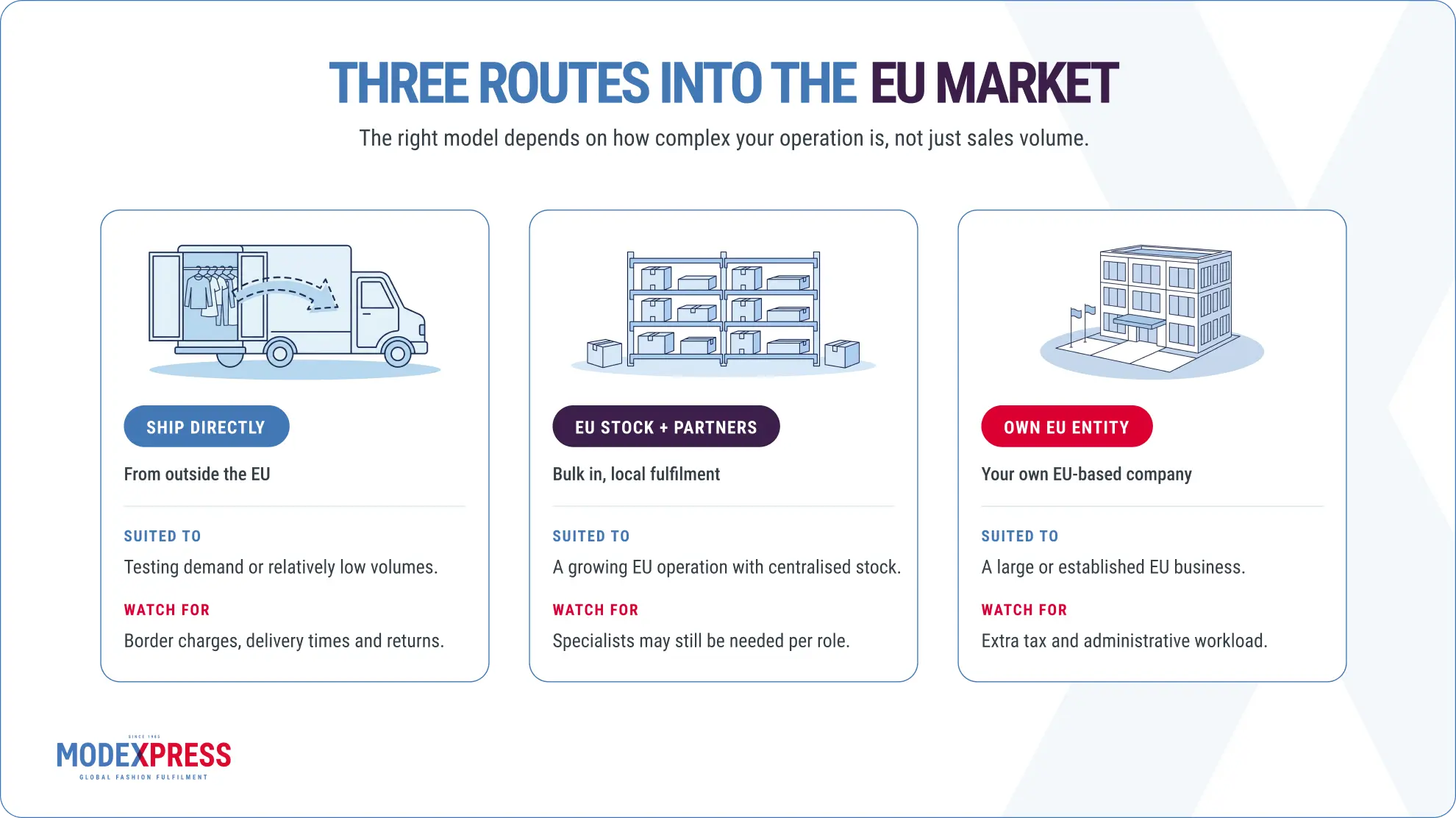
Three routes into the EU market, with different operational responsibilities.
Ship directly from outside the EU
This can work well if you’re testing demand or selling relatively low volumes. Each order crosses the border, so you should factor in customs charges, delivery times, returns, and the admin involved in fixing problems.
Hold stock in the EU and use specialist partners
As your European operation grows, it’s often easier to send stock into the EU in bulk and store it there. Fulfilling orders locally means fewer individual border crossings and makes it easier to serve e-commerce and traditional retail from the same stock.
Under the Union Customs Code, goods held in a bonded warehouse can remain under customs supervision without import duty becoming due. However, storing stock in Europe doesn’t make one provider responsible for everything. You may still need separate specialists for product safety, EPR, VAT, and other regulatory roles.
Establish your own EU business
This can give you more control and may open up more customs options, but it also brings extra tax and administrative work. It usually makes more sense once your European business is large or established enough to justify that commitment.
Tighten up your records and hand-offs
Make sure everyone knows who owns each piece of information, and don’t mix static product facts with details that change from shipment to shipment.
For example:
- Product information: what the garment is made from, where it comes from, its SKU, or classification.
- Shipment information: how many units are present, invoice value, buyer, and transaction details.
Once you’ve set up your data processes, try testing them by changing something. If you update an item’s fibre blend, can another team member identify the affected records and notify the relevant partners? Also see how quickly you can retrieve evidence when someone raises a query.
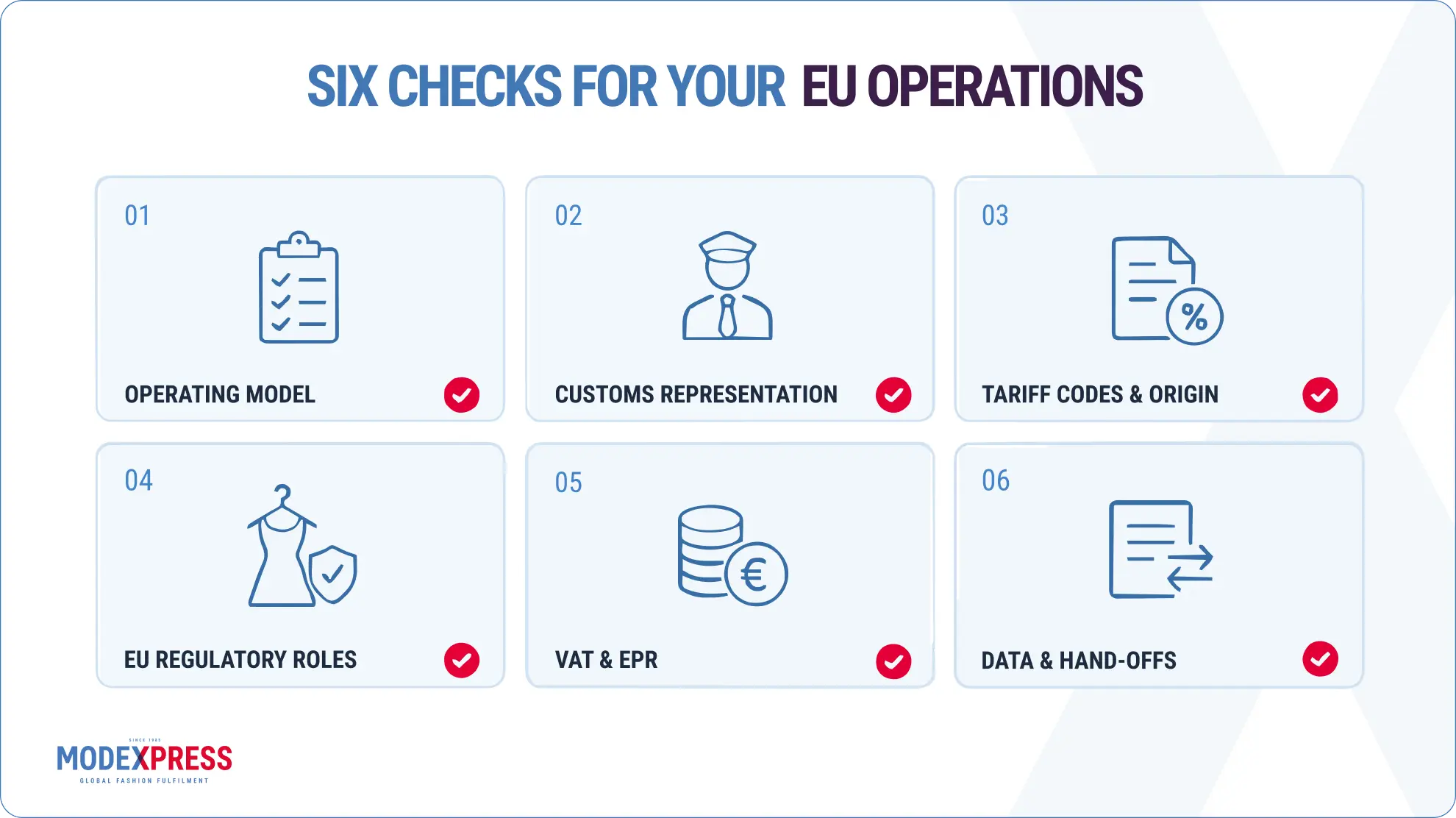
Six areas to check when organising your EU operations.
Even if stock doesn’t sell, you still need to know what happened to it. Under ESPR’s destruction prohibition, large companies face restrictions on destroying specified unsold apparel and footwear from 19 July 2026, subject to exceptions. Your records should show whether stock was resold, repaired, recycled, or dealt with in another way, so there’s a clear trail of what happened to it.
Assign responsibility for recording each stock disposition and linking it to warehouse movements, transport records and processor evidence. Check that the chosen treatment is permitted before goods leave the warehouse, and retain the evidence supporting that decision.
How Modexpress supports your EU setup
At Modexpress, our role centres on fashion logistics, customs operations, bonded warehousing, documentation, and reporting. Our AEO status and fashion-specific fulfilment capabilities support brands that want to enter the EU market. Indirect customs representation remains subject to our assessment of the proposed operation.
We help brands work through their customs setup, prepare documentation, coordinate information between partners and support reporting requirements. Where additional expertise is needed, we can connect brands with the right specialists. Product-compliance and fiscal responsibilities must be agreed separately. Modexpress does not provide fiscal representation directly; this is arranged through an external partner.
“Before the first shipment, everyone should know what they are responsible for and what information they need from each other. Our role is to help brands make those arrangements work in practice.”
Discuss your operational customs setup with our team
Before committing to an EU launch, establish who will accept each role and what evidence they need. Resolving problems while the goods are still with your supplier gives you more time to fix things compared to only discovering them when a shipment is waiting to clear.
If you’re working out how customs, warehousing and your wider partner network should fit together, we can help. Discuss your operational customs setup with our team.
Frequently asked questions
What is indirect customs representation and why can it be difficult for non-EU brands to obtain?
Indirect customs representation is when a customs representative acts in its own name on your behalf. Both parties may owe the customs debt, so the representative takes on real financial risk. That’s why customs providers often like to do an in-depth check of your product data, processes, and compliance history before agreeing to represent you.
Do we need one EU authorised representative?
Not necessarily. Different EU rules create different roles, so it depends on what they are representing. A customs representative is not automatically responsible for product safety, and a fiscal representative does not automatically cover EPR. GPSR, customs, national EPR schemes and VAT arrangements can involve different parties.
One provider may sometimes perform more than one role, but only where it is legally allowed and has explicitly agreed to take on that responsibility.
Does GPSR apply to clothing, footwear and fashion accessories?
Yes, GPSR generally applies to consumer products such as clothing, footwear and fashion accessories sold in the EU. Products covered by the regulation need a responsible economic operator established in the EU. The required product, manufacturer, and responsible-person information must be provided where the regulation requires it.
Is the temporary duty €3 per garment?
Several garments under the same tariff subheading can attract a single €3 charge. Garments under different tariff subheadings can create separate charges.
Does IOSS remove the customs duty?
No. IOSS handles VAT and does not generally exempt goods from this duty. Qualifying preferential-trade or customs-union goods may receive different treatment under the declaration conditions described in the Commission guidance.
When do textile DPPs become compulsory?
There isn’t a final date yet. ESPR is establishing the Digital Product Passport framework, but the rules for textiles will determine exactly what information fashion products need to carry and when the requirements apply. In the meantime, it’s a good idea to get your product and supplier data in order so you’re ready to adapt when the final rules are published.
Can a logistics provider be our importer of record?
Ask what that term means in the proposed contract. Indirect customs representation does not automatically include product-safety or VAT responsibilities, for instance, so it’s worthwhile checking exactly what will be covered.
What data should we prepare for a customs partner?
Bring the basic information about your products, suppliers, and shipments, including tariff codes, origin evidence, values, and expected sales volumes. You should also be able to show where the information came from and who can answer questions or correct it if something is wrong.
Related posts
Modexpress expands customer portfolio with new omnichannel and international partnerships
9 October 2026Over the past period, several new brands have started working with Modexpress. We are pleased ...

Contributing to a smooth and compliant customs process
5 October 2026As an administrative employee within the Customs Department, Joyce Matthews has developed the knowledge and ...
Customer story: How New Amsterdam Apparel is scaling international growth
6 August 2026International expansion creates exciting opportunities, but it also brings operational challenges. How do you maintain ...
Discover what Modexpress can do for your brand. Download our brochure after submitting your details.
"*" indicates required fields