Digital Product Passport (DPP) for fashion: how the new EU rules will reshape brands
Last updated on 17 July 2026
Digital product passports will soon be a legal requirement for fashion brands in Europe. The EU DPP Registry went live on 19 July 2026, the first ecodesign rules for unsold clothing already apply, and the textile delegated act is expected in 2027. Together, these mark the shift from policy discussion to operational reality.
While they demand new systems, data, and investment, they also open the door to stronger consumer loyalty and a reputation for genuine sustainability.Recent research by PwC Strategy&, based on 2,000 consumers in Germany and Austria, found that 49% show higher purchase intent for fashion items when origin and materials are verifiable through a DPP, and 74% are willing to pay a premium for fully traceable, sustainability-verified items. Earlier findings from Vogue Business already showed that 53% of luxury consumers had heard of DPPs and 25% were familiar with some of their functions. Early adopters can use these credentials to outpace slower competitors before compliance becomes a market baseline.
What is the Digital Product Passport (DPP)?
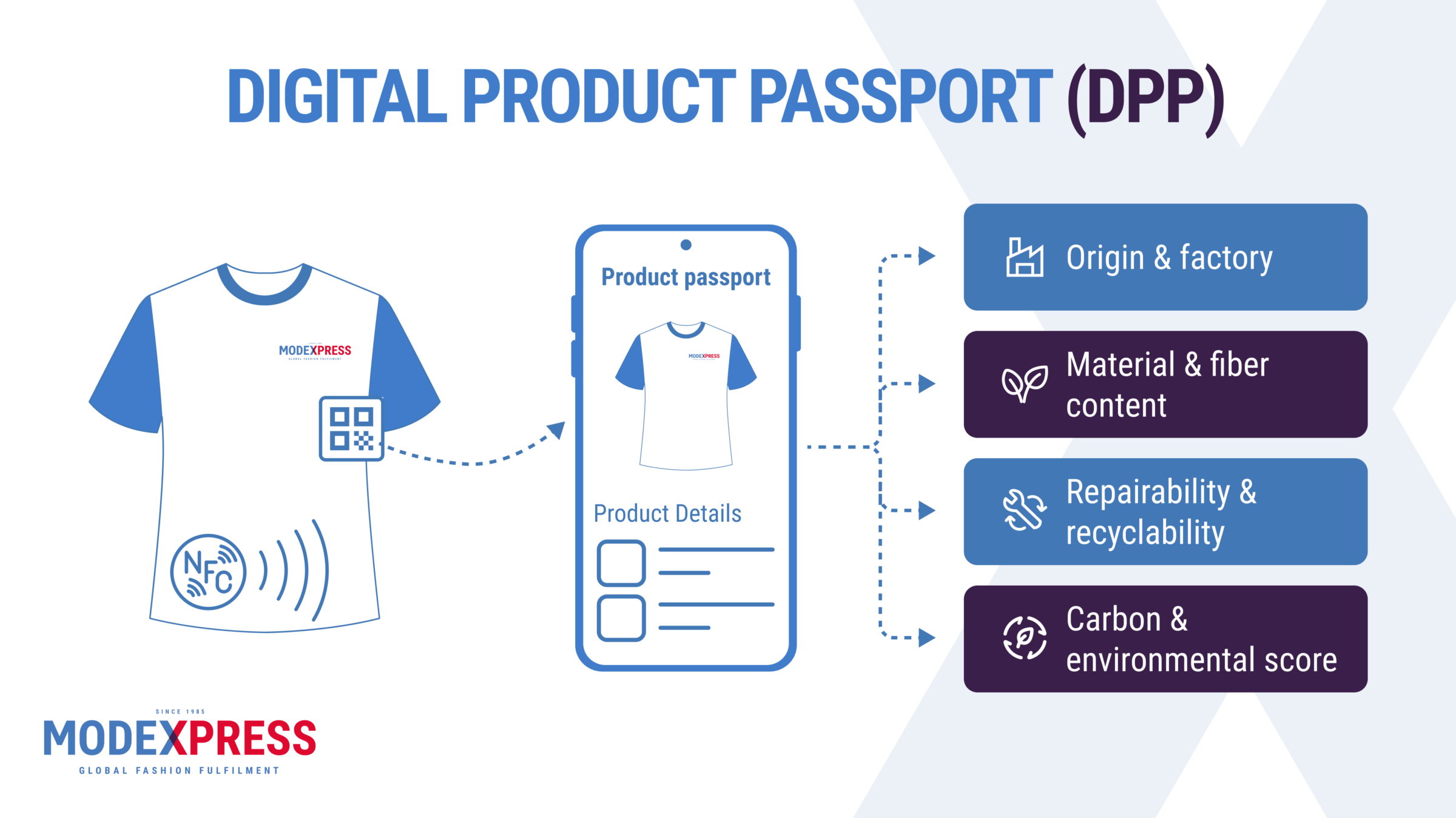
The DPP is a digital record that’s linked to each product. It’s designed to make the product more transparent in terms of:
- origin,
- materials,
- repair and recycle options,
- and other environmental performance details.
As a recent European Parliament study stated, “A European digital product passport (DPP) could enhance textile industry traceability, circularity, and transparency.” The concept of a DPP came about after the introduction of the Ecodesign for Sustainable Products Regulation (ESPR), which entered into force on 19 July 2024. It sits alongside two related regulations that fashion brands should track: the EU Textile Regulation (EU) 1007/2011 on fibre composition labelling and the Green Claims Directive, which takes effect in September 2026. The goal is that each product must carry a QR code or NFC tag that links to its digital product passport. People should be able to scan with a smartphone and see all the relevant product details.
Overall, the DPP will help to show the environmental impact of every item, encouraging brands to make products more durable and reusable. This level of transparency should also help to build consumer trust and loyalty.
Why pay attention to DPP now?
The ESPR Working Plan 2025–2030 plan (adopted 16 April 2025) puts textiles and apparel among the highest-priority sectors for DPP, second only to iron and steel. On 27 May 2026, CEN and CENELEC published the first six horizontal DPP standards. The textile delegated act itself, which defines the specific data fields for fashion, is expected to be adopted in 2027. After that, a compliance window of around 18 months is expected to kick in for apparel, with footwear following later. The introduction of DPP marks a sharper focus on supply chain documentation. This means brands should start improving data quality and traceability now in preparation.
What will be in the DPP?
Although the final delegated acts aren’t published yet, we already have a clear idea of what fashion passports will include. Each product will carry the following information.
- Core product data – origin, fibre content, sustainability credentials
- Unique identifier – usually a GS1-serialised code kept for the item’s lifecycle
- Data carrier – most likely a QR code linking to the passport
- Interoperable IT systems – to ensure data can be shared across the supply chain
The passport is expected to cover around 125 key data points. Over time, it will support circular models by allowing repairers, recyclers, and resale platforms to add updates on a product’s condition and history.
It’s best to think of the DPP as a “living record” that follows an item from factory to consumer, through resale, repair, and recycling. It’s a big step forward in product transparency and brands that prepare for this change early can turn compliance into a competitive advantage.
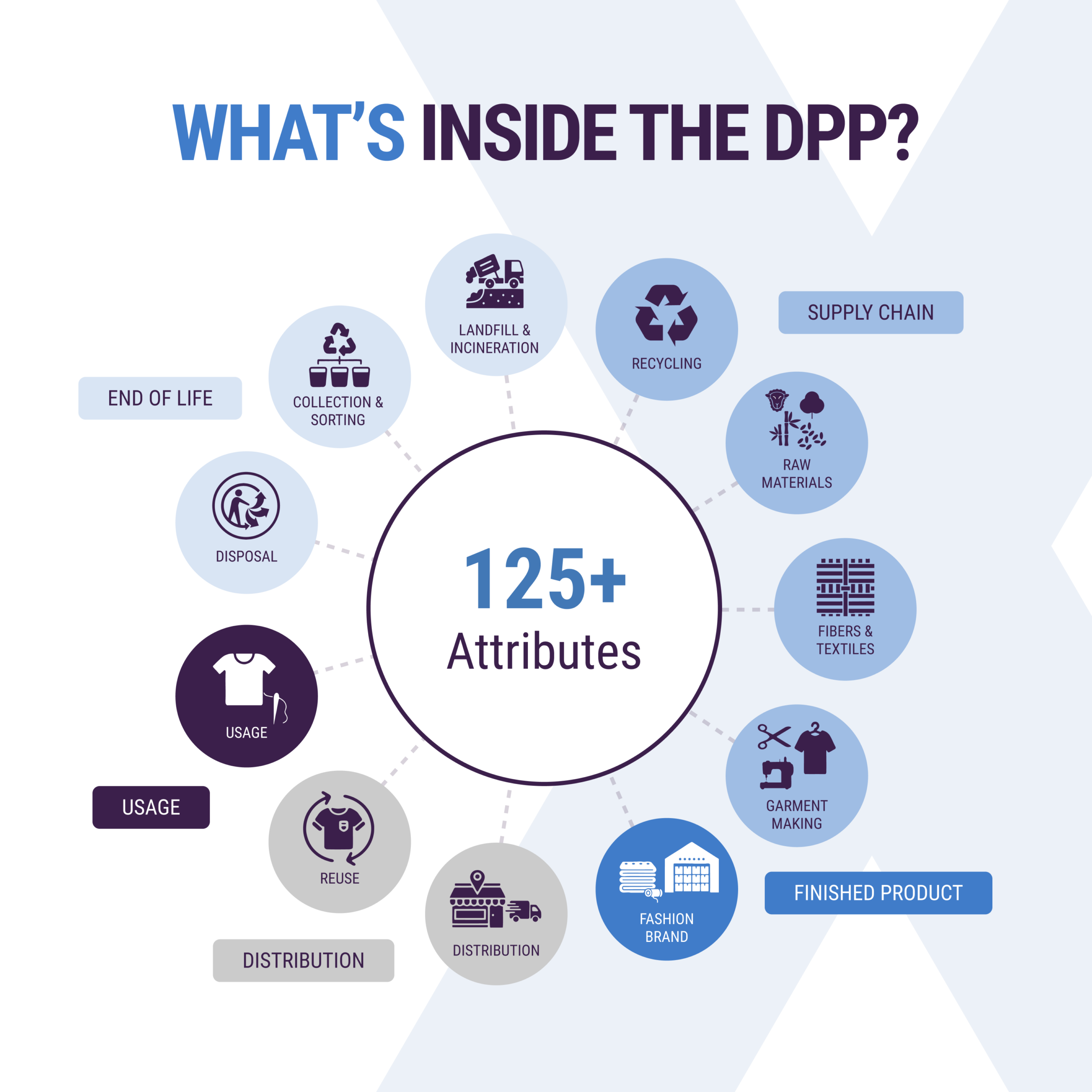
Digital product passport – What’s inside?
Impact on fashion companies
The consequences of non-compliance are expected to be severe. Without a compliant DPP, products may not be allowed on the EU market. The Commission is likely to monitor compliance through market checks, with warnings issued first and products blocked from sale if problems remain. Imported goods are also covered, as ESPR applies equally to EU and non-EU companies. The business placing the product on the market is responsible for creating and maintaining the DPP.
“Fashion brands should be prepared well in advance to avoid shipment delays or even sales bans. Having an EU entity is increasingly preferred to stay in control.”

Non-EU brands should appoint an EU-based operator, either an importer or authorised representative, to take responsibility for the DPP and technical file access. Preparation should start now, particularly for non-EU brands facing additional logistics hurdles. As an indicator of the importance of preparation, a recent Times report warned of the commercial risk of lost EU sales if UK companies delay readiness.
DPP timelines (2026 – 2030)
It’s a good idea to start preparing for the introduction of DPP now, as it means you can hit the ground running when the rules eventually come in.
- 19 July 2024: ESPR (Regulation (EU) 2024/1781) enters into force.
- 16 April 2025: The Commission adopts the first ESPR Working Plan 2025-2030, confirming textiles as the second priority category after iron & steel.
- 9 February 2026: The Commission adopts the Delegated Regulation and Implementing Regulation for the destruction ban and disclosure format.
- 27 May 2026: CEN/CENELEC publishes the first six horizontal DPP standards (EN 18xxx family), the technical foundation for all future DPPs.
- 19 July 2026: EU DPP Registry goes live. Article 25 destruction ban applies for large fashion undertakings. Disclosure regime activates.
- 18 February 2027: Battery passport becomes the first mandatory sector-specific DPP under the Battery Regulation. This is the operational proof-of-concept for the entire DPP system.
- Indicative 2027: Textile delegated act adopted (subject to formal Commission proposal expected late 2026).
- Late 2028 to early 2029: Textile compliance date, roughly 18 months after delegated act adoption (indicative).
- 19 July 2030: Destruction ban extends to medium-sized fashion companies.
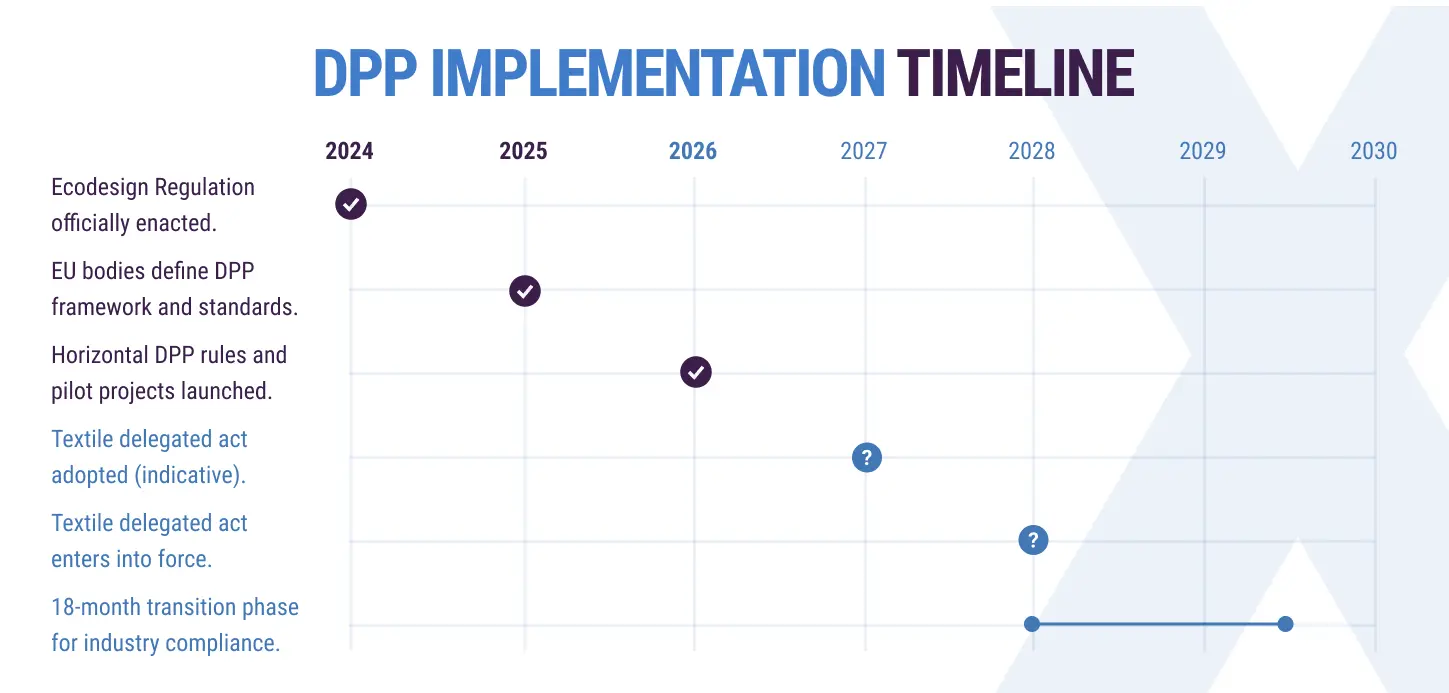
Modexpress – Digital product passport – Timeline (updated)
What “good” preparation looks like for fashion brands
In order to prepare for digital product passports, brands must focus on data quality across the supply chain and product lifecycle.
Step one – map your data
Align your data with the likely DPP schema (materials, fibre content, chemicals, facility IDs, repairability/recyclability). Involve supply chain partners to ensure accuracy.
Step two – select your tech
Choose IDs & carriers early (serialised GTIN + QR) and ensure systems can carry the ID across the product lifecycle and channel handovers. Start testing systems and formats for product data as early as possible, so there are no glitches when it’s finally rolled out.
Step three – connect your systems
Make sure your IT and supply chain systems can “talk” to each other and share data smoothly. Keep an eye on the official EU standards being developed (CEN/CENELEC JTC 24), as these will define how systems should link up and exchange DPP information. Partnering with a third party can make this process easier, especially for non-EU brands.
How Modexpress supports clients during this transition
While Modexpress can’t take on full legal responsibility for your compliance, we do provide practical support to help fashion brands get ready for DPP and manage the change.
- Guidance from the start – advice and feedback during onboarding to flag risks early.
- Ongoing checks – regular sample reviews of documentation to keep everything on track.
- Tools & know-how – templates and best practices built from decades of fashion logistics experience.
What makes Modexpress different is our dedicated customs department. Beyond paperwork, the team acts as a sparring partner to navigate EU entry rules and DPP requirements.
“DPP brings new expectations for brands, and we want to make that transition as smooth as possible. Our customs experts guide clients through what’s needed and provide the tools to organise compliant documentation.”

With compliance expertise and logistics support combined, Modexpress makes the DPP journey far less daunting. To discuss how you can prepare for DPP in more detail, reach out to our team today.
Related posts
Modexpress expands customer portfolio with new omnichannel and international partnerships
9 October 2026Over the past period, several new brands have started working with Modexpress. We are pleased ...

Contributing to a smooth and compliant customs process
5 October 2026As an administrative employee within the Customs Department, Joyce Matthews has developed the knowledge and ...
Customer story: How New Amsterdam Apparel is scaling international growth
6 August 2026International expansion creates exciting opportunities, but it also brings operational challenges. How do you maintain ...

Discover what Modexpress can do for your brand. Download our brochure after submitting your details.
"*" indicates required fields